What Is Caustic Soda? Flake vs Liquid Caustic Soda and Industrial Uses
Caustic soda, chemically known as sodium hydroxide (NaOH), is one of the most widely used strong bases in industry. It is consumed in paper making, detergents, textiles, water treatment, alumina production and the chemical industry. To buy caustic soda well you are not just choosing one product: you must decide between flake and liquid, between membrane and commercial grade, and between different concentrations and technical documents, and these decisions determine the final cost, safety and process quality.
This guide is written for purchasing managers, process engineers and traders. Its technical figures are taken from published material of major caustic soda producers, the PubChem database and safety data sheets (SDS); the list of sources is at the end of the article. Where a figure belongs to one manufacturer's product, that is stated at the point of use.
Quick Summary
- Caustic soda is commonly supplied in two forms: solid (flakes or beads) and aqueous solution; the most common commercial solution strength is 50% by weight [1].
- The 50% solution freezes at about 12 to 13 degrees Celsius; winter transport and storage without insulation and heating can cause freezing and blocked valves [1][3].
- Membrane grade contains less than 100 ppm salt (NaCl), while commercial grade contains about 1% salt by weight; for chloride-sensitive processes this difference matters [1].
- Aluminum, zinc, tin, copper and brass are not suitable for contact with caustic soda [1].
- Before you buy caustic soda, obtain the TDS and SDS for the exact concentration and, where possible, the COA of the same lot.
What Is Caustic Soda (Sodium Hydroxide)?
Sodium hydroxide has the formula NaOH and CAS number 1310-73-2. Other common names are "caustic," "lye" and "caustic lye" [1]. It is a very strong base: a 50% solution has a pH above 14, and the measured pH only falls below 14 once the solution is diluted to below about 3.88% [1].
Industrial production is by electrolysis of brine (the chlor-alkali process), which also yields chlorine and hydrogen. Three cell technologies are known: membrane, diaphragm and mercury; membrane and diaphragm caustic are the two common commercial grades on the market [1][7].
| Property | Value | Source |
|---|---|---|
| Molar mass | 39.997 g/mol | [1] |
| Melting point | about 323 °C (322.85 °C) | [1] |
| Solid density (25 °C) | about 2.10 g/cm³ | [1] |
| Solubility in water (20 °C) | about 109 g per 100 mL | [2] |
| Transport numbers | solid: UN 1823; solution: UN 1824; Class 8 (corrosive), packing group II | [6] |
| GHS classification | H290 (may be corrosive to metals) and H314 (causes severe skin burns and eye damage) | [6] |
Solid caustic soda is hygroscopic and quickly absorbs water and CO₂ from the air; for this reason sealed packaging and dry storage are essential [1][5].
Flake vs Liquid Caustic Soda
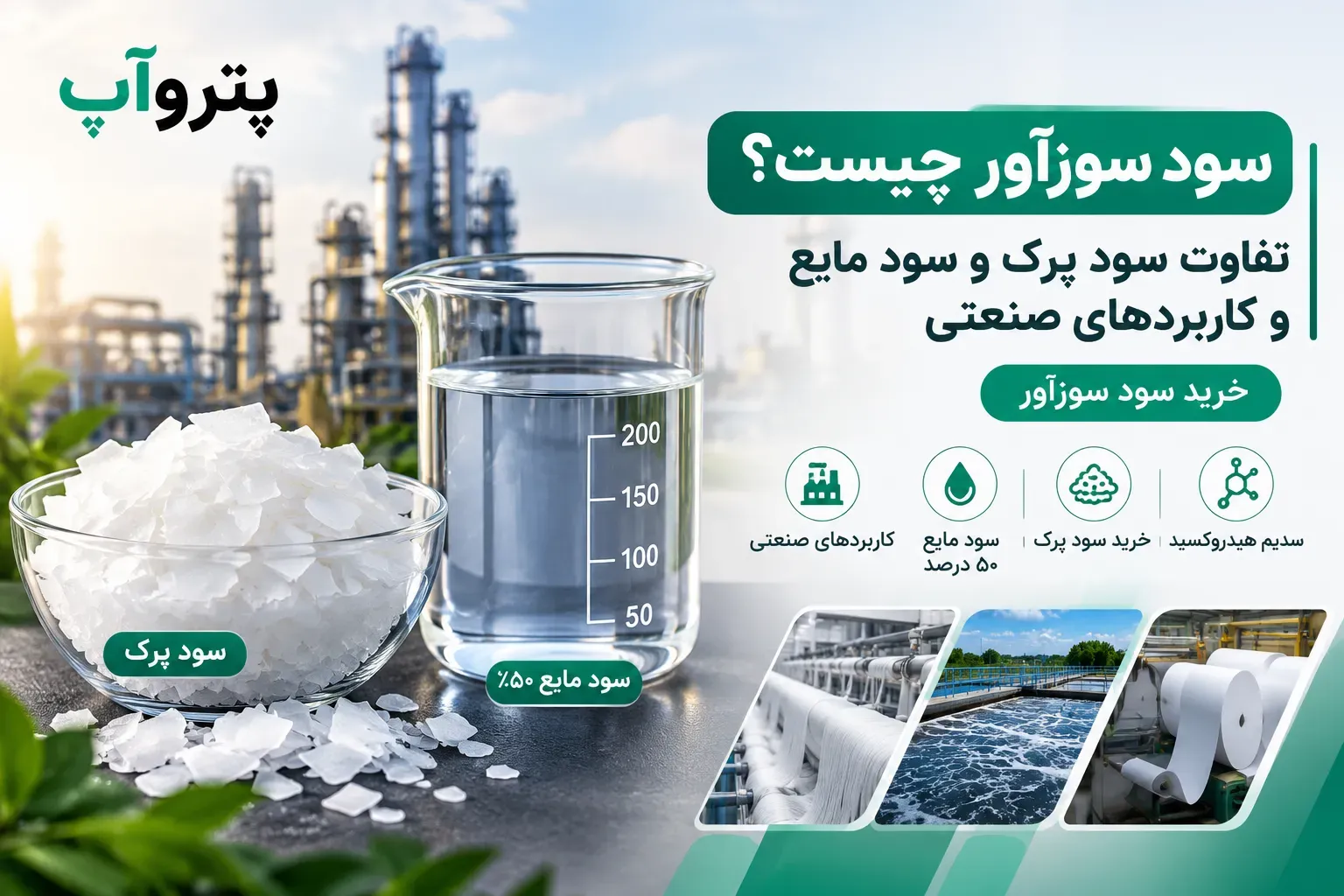
Flake caustic soda is the solid, water-free form of sodium hydroxide, and the buyer dissolves it with water at the point of use to the required concentration. Liquid caustic soda is a ready solution, usually supplied at 50% by weight, which needs no preparation but has a fixed concentration, and its transport includes the weight of the water.
| Criterion | Flake caustic soda | Liquid caustic soda (e.g., 50%) |
|---|---|---|
| Supply form | White solid flakes or beads | Aqueous solution in tankers, tanks or drums |
| How quantity is stated | Percent NaOH purity in the solid | Percent by weight NaOH in the solution (must be stated explicitly) |
| Storage | Sensitive to moisture and air CO₂; needs sealed packaging | Needs a compatible tank and attention to freezing point (12 to 13 °C for 50%) |
| Preparation | Dissolving in water, strongly exothermic | Ready to use or needs controlled dilution |
| Transport weight | Active material only | Includes water; the 50% solution weighs about 1.5 times as much as water [1] |
| Suited to | Low to medium consumption, no tank available, need for varied concentrations | Continuous, high-volume use with suitable tanks and pumps |
The choice between the two depends on process needs, equipment at the point of use and total delivered cost, not just the base price. First clarify the technical requirement, then choose the supply form.
Membrane Grade and Commercial Grade of 50% Liquid Caustic Soda
In the global market, 50% liquid caustic soda is usually supplied in two grades. The producer Olin defines them as follows [1]:
| Characteristic | Membrane grade | Commercial / diaphragm grade |
|---|---|---|
| Salt (NaCl) | typically below 100 ppm | about 1% by weight |
| Trace metals | Low | Higher than membrane grade |
| Appearance | Clear and colorless | Sometimes slightly hazy or milky |
| Typical use | Processes sensitive to chloride or metals | Most general uses where these impurities are not critical |
The published specification of one supplier's 50% membrane caustic soda (Harcros) gives these ranges: NaOH between 49.0 and 51.5%, NaCl at most 100 ppm, iron at most 3.0 ppm and specific gravity from 1.49 to 1.53 [4]. These figures are an example of one product; the specification of your product must be read from the TDS of that supplier.
Standards also exist for regulated uses; for example, producers mention AWWA B300 and NSF/ANSI 60 certification (drinking water treatment chemicals) and the Food Chemicals Codex (food use) [1]. General industrial use does not mean the product is suitable for food or drinking water use.
Freezing Point and Winter Storage of Liquid Caustic Soda
The 50% solution has a fairly high freezing point: Olin reports 12 to 13 °C [1] and the Westlake Vinnolit data sheet reports about 12 °C [3]. This has high practical importance for winter purchasing:
- Viscosity of the solution rises rapidly when the temperature falls below about 16 °C, making pumping difficult [1].
- Outdoor tanks and pipes need insulation and heating; Olin recommends heat tracing pipes when ambient temperature is expected to approach about 21 °C [1].
- Valves and connection points are not insulated and are usually the first places to freeze; they must never be heated with a direct flame, and low-pressure steam should be used [1].
- For road or rail deliveries, record the temperature of the load at delivery on the delivery document or at inspection.
Industrial Applications of Caustic Soda
Caustic soda is a base chemical for many industries. The list below shows well-known applications; whether a specific product suits an application must be checked against grade, purity and permitted impurities.
- Paper and pulp: in the Kraft process, sodium hydroxide together with sodium sulfide forms the "white liquor" used to separate lignin from cellulose fibers [7][8].
- Soap and detergents: used in saponification of fats and oils and in the production of detergents [7][8].
- Textiles: used in textile processes, including mercerization of cotton [8].
- Water and wastewater treatment: used to raise pH, neutralize acidic effluent, precipitate heavy metals and regenerate ion-exchange resins [8].
- Alumina: used in the Bayer process to dissolve alumina from bauxite ore [7][8].
- Chemical and refining industries: used for pH control, acid neutralization, off-gas scrubbing, removal of sulfurous impurities from crude oil, and in making biodiesel (as a catalyst), rayon and cellophane [5].
- Edible oils and metalworking: used in refining vegetable oils and in metal degreasing [5].
- Food industry (only with an approved grade): examples include chemical peeling of fruit and vegetables and cocoa processing [9]. Food use requires the relevant grade and approval.
Key Technical Specifications When You Buy Caustic Soda
| Specification | What to check |
|---|---|
| Supply form | Flake/beads or solution; for solution, the exact concentration and unit (percent by weight) |
| Grade | Membrane, commercial, food or other; documents supporting the grade |
| Impurities | Total alkalinity, carbonate, chloride (NaCl), iron and sulfate in the COA; these five parameters are covered by the standard method ASTM E 291 [1] |
| Appearance | Clarity and color of the solution; membrane grade is clear and commercial grade may be hazy [1] |
| Packaging and transport | Packaging type, volume or weight, compatibility with the material, temperature conditions of transport |
| Equipment compatibility | Material of the tank, hose, pump and fittings at the point of use |
For sampling the solution, Olin recommends a clean, dry polyethylene bottle and advises against glass, because caustic soda etches glass; the sample should also have minimal contact with air [1]. The permitted ceiling for each impurity is set by the contract or the grade standard and should not be generalized from one producer's product to the whole market.
TDS, SDS and COA Compared
| Criterion | TDS (technical data sheet) | SDS (safety data sheet) | COA (certificate of analysis) |
|---|---|---|---|
| Content | Defined product specifications, properties and uses | Hazards, safety, storage, transport and first aid | Actual analysis results of one lot |
| Scope | One product | One product (and a specific concentration) | One specific lot |
| Purpose | Product selection | Safety at work and in transport | Confirming lot conformity |
These three documents are not interchangeable. The SDS must be for the concentration you purchase, and the COA must belong to the same lot. Olin stresses that the SDS must always be available to everyone at the workplace and that the latest version should be reviewed [1].
Step-by-Step Guide to Buy Caustic Soda
- Define the end use and the technical requirements of the process.
- Choose the supply form (flake or liquid) based on equipment and consumption volume.
- Set the purity (flake) or concentration (liquid) with the exact unit and the required grade.
- Clarify the order quantity, delivery location and unloading facilities (tank, pump, ventilation).
- Obtain the TDS and SDS for the same product and concentration.
- Request the COA of the same lot and match the lot number to the package or delivery document.
- Compare prices on the same basis (see the price section).
- Put packaging, transport, delivery temperature and the responsibilities of the parties in writing.
- Settle payment and delivery terms before finalizing the order.
Choosing a Supplier When You Buy Caustic Soda
- Provision of the TDS and SDS and, on request, the COA of the same lot.
- Clear statement of purity or concentration, grade and basis of measurement.
- A verifiable business identity (address, phone number, registered company).
- Transparent disclosure of transport, packaging and insurance costs.
- Offering a grade that suits your need, not merely whatever is in stock.
- Responsibility for transport, unloading and quality claims defined in the contract.
Documents alone are not a guarantee of quality. In large or sensitive deals, analysis of a sample in an independent laboratory is reasonable.
What Does the Price of Caustic Soda Depend On?
The price of caustic soda is not fixed, and no price figure is given in this article; for the current price, obtain an official quotation from suppliers. The main factors affecting price are:
- Supply form (flake or liquid) and concentration or purity.
- Grade (membrane, commercial, food) and how strict the impurity specifications are.
- Order quantity and packaging type (bulk or small packs).
- Delivery location, distance and transport cost (in a solution, water is transported too).
- Market conditions, time of inquiry and payment terms.
Comparing prices correctly: divide the price per kilogram of product by the mass fraction of active material. For the 50% solution, the cost of one kilogram of pure NaOH equals the price per kilogram of solution divided by 0.5; that is, if the 50% solution costs X per kilogram, each kilogram of active NaOH in it costs 2X. For flake of 98% purity (as an example), divide by 0.98. Then add the transport cost per kilogram of active material, because in a solution part of the shipped weight is water.
Caustic Soda Safety
Sodium hydroxide is corrosive. Its GHS classification includes H290 (may be corrosive to metals) and H314 (causes severe skin burns and eye damage) [6]. Olin warns that eye contact can cause permanent damage, caustic mist or dust is hazardous to the respiratory tract, and ingestion causes severe gastrointestinal damage [1]. In product SDSs, the occupational exposure limits reported are an OSHA PEL of 2 mg/m³, a NIOSH REL of 2 mg/m³ (ceiling) and an IDLH of 10 mg/m³ [6]. Take the permitted limits for your own country from that country's occupational safety regulations.
Personal protective equipment
According to Olin's guide, safety glasses are required for routine work, and for splash-prone work both chemical goggles and a face shield; for sampling, line breaking or maintenance, neoprene (or equivalent) clothing, gloves and boots are recommended, and a suitable respirator should be available where mist or dust is possible [1]. A safety shower and eyewash must be on the same level as the hazard, without obstacles, within about 10 seconds of reach (ANSI Z358.1) [1].
Compatible materials and equipment
- Carbon steel is suitable for tanks holding 50% and weaker solutions up to about 49 °C; stainless steel 304L and 316L up to about 71 °C; nickel and its alloys for higher temperatures [1].
- High-density polyethylene (HDPE) and FRP can be used for small volumes [1].
- Aluminum, zinc (including galvanized pipe), tin, copper and brass must never be in contact with caustic soda [1].
- Avoid glass in flow meters or rotameters [1].
Incompatible materials
Keep caustic soda away from strong acids, since the reaction can be violent. Nitrogen-containing organic compounds, explosives, carbohydrates, phosphorus, organic peroxides and hydrocarbons may also react with caustic soda, sometimes violently [1]. The reaction of caustic soda with carbohydrates can produce carbon monoxide gas, so before entering a tank or equipment, safe confined-space entry procedures must be followed [1].
Heat release during dilution
Mixing caustic soda with water or acid releases a great deal of heat and may cause spattering; Olin recommends that this be done only by trained personnel in equipment designed for it [1]. Take the order of addition and the permitted temperature from the SDS of your product.
First aid (summary of Olin's guide)
- Eyes: flush immediately with water for at least 15 minutes, holding the eyelids open, without soap, and seek medical attention immediately [1].
- Skin: flush with plenty of water for at least 15 minutes, remove contaminated clothing and jewelry, and seek medical attention immediately [1].
- Swallowing: do not induce vomiting, give large quantities of water to drink (if the person is conscious) and seek medical attention immediately [1].
- Inhalation: move to fresh air immediately and seek medical attention [1].
- Do not use acid to neutralize caustic soda on skin or eyes unless a physician directs it [1].
This summary does not replace the SDS of the product or your workplace safety procedure. For transport, the solid is identified as UN 1823 and the solution as UN 1824, Class 8, packing group II [6]; also follow the transport regulations of your own country.
Common Mistakes When You Buy Caustic Soda
- Choosing on price alone, without comparing on the basis of active material.
- Ordering "liquid caustic soda" without stating concentration and grade.
- Ignoring the 12 to 13 °C freezing point of the 50% solution in winter purchasing [1].
- Using aluminum, galvanized or brass tanks, valves or pipes [1].
- Receiving an SDS for a different concentration or a COA for another lot.
- Using an industrial product for food or drinking water applications without the relevant grade and approval.
- Sampling in a glass container [1].
How to Buy Caustic Soda Through Petroup
Petroup is a specialized online marketplace for petrochemical, chemical and refinery products. The features described on its "About Us" page include buy and sell listings with advertiser contact details visible without registration, requests for quotation (RFQ) and supplier offers, sealed-bid online auctions and tenders, and company and supplier profiles.
According to Petroup's terms, the platform is a listing and introduction service and is not a party to any sale contract; the accuracy of listings, product quality, delivery and settlement are the responsibility of the trading parties. So request the TDS, SDS and COA directly from the supplier and review them before ordering. To submit a request or ask about caustic soda, you can use the contact page.
Frequently Asked Questions
What is caustic soda and what is it used for?
Caustic soda is sodium hydroxide (NaOH), a very strong base used in paper making, soap and detergents, textiles, water treatment, alumina production and the chemical industry. Food and drinking water uses are permitted only with the relevant grade and approval.
What is the difference between flake and liquid caustic soda?
Flake caustic soda is solid and its purity is expressed as a percentage; liquid caustic soda is an aqueous solution of a stated concentration (the most common is 50% by weight). Flake must be dissolved at the point of use, whereas liquid is ready to use and the weight of water is part of its transport.
At what temperature does 50% liquid caustic soda freeze?
The freezing point of the 50% solution is reported as about 12 to 13 degrees Celsius [1][3]; so storage and transport in cold weather need insulation and heating.
What is the difference between membrane and commercial caustic soda?
Membrane caustic soda typically contains less than 100 ppm salt (NaCl), while commercial caustic soda contains about 1% salt by weight and may also contain more trace metals [1]. For chloride-sensitive processes, membrane grade is more suitable.
What documents should I request when I buy caustic soda?
The TDS of the product, the SDS for the same form and concentration and, where possible, the COA of the same lot. All three must match the product being traded.
What does the price of caustic soda depend on?
On supply form, concentration or purity, grade, order quantity, packaging, delivery location and transport cost, market conditions and payment terms. To compare, calculate the cost per kilogram of active NaOH.
What tank material is suitable for storing caustic soda?
According to Olin's guide, carbon steel (up to about 49 °C), stainless steel 304L and 316L (up to about 71 °C) and nickel for higher temperatures are suitable; aluminum, zinc, tin, copper and brass are not [1].
What should I do if caustic soda gets on skin or in the eyes?
Immediately flush with plenty of water for at least 15 minutes and seek medical attention without delay [1]. Read the details in the product SDS.
Conclusion
To buy caustic soda, settle five key decisions: supply form, concentration or purity with the exact unit, grade, technical documents (TDS, SDS, COA), and transport and storage conditions, including freezing point and equipment compatibility. If you plan an industrial purchase, write down your technical requirement before inquiring and request quotations from suppliers who provide their documents transparently.
References
- Olin Chlor Alkali, Caustic Soda: Sodium Hydroxide Product Stewardship Manual — olinchloralkali.com
- PubChem, Sodium hydroxide — pubchem.ncbi.nlm.nih.gov
- Westlake Vinnolit, Product data sheet NaOH 50% (2022) — westlakevinnolit.com
- Harcros, Caustic Soda 50% Membrane — harcros.store
- Thermo Scientific Chemicals, Sodium hydroxide, flake, 98% — thermofisher.com
- Safety data sheets (SDS) for sodium hydroxide, Alliance Chemical and Columbus Chemical (GHS classification, exposure limits, UN numbers)
- ChemEurope, Sodium hydroxide (production processes and uses) — chemeurope.com
- Alliance Chemical, Industrial sodium hydroxide manufacturing and caustic soda applications — alliancechemical.com
- USPTO, US Patent 9,187,834 (description of sodium hydroxide uses) — uspto.gov